 CTF WriteUps
3 - pretty_devilish_file
Time spent: ~2.5 hours
Tools used: qpdf, Python
Challenge 3 is probably my least favorite challenge of this year. It is very much a guessing game on what you need to do and what tools you need to use.
You are served a horribly broken PDF file which behaves differently in different PDF readers, that contains the text “Flare-On!”. Okular so happens to be one of the very few that is actually able to dispay it:
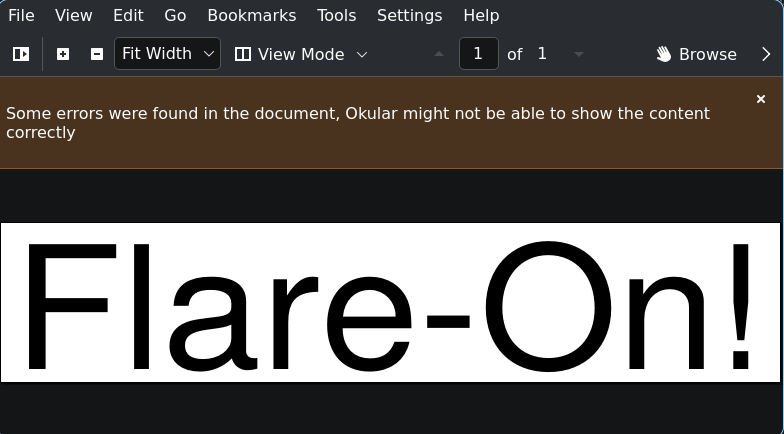
Nothing on the visual side of the PDF shows any signs of a flag though. Clearly there must be something hidden in the file.
Finding the Hidden Data
Looking into the file itself, the file seems to be intentionally “obfuscated” (for the lack of a better term), and there is some encrypted payload present.
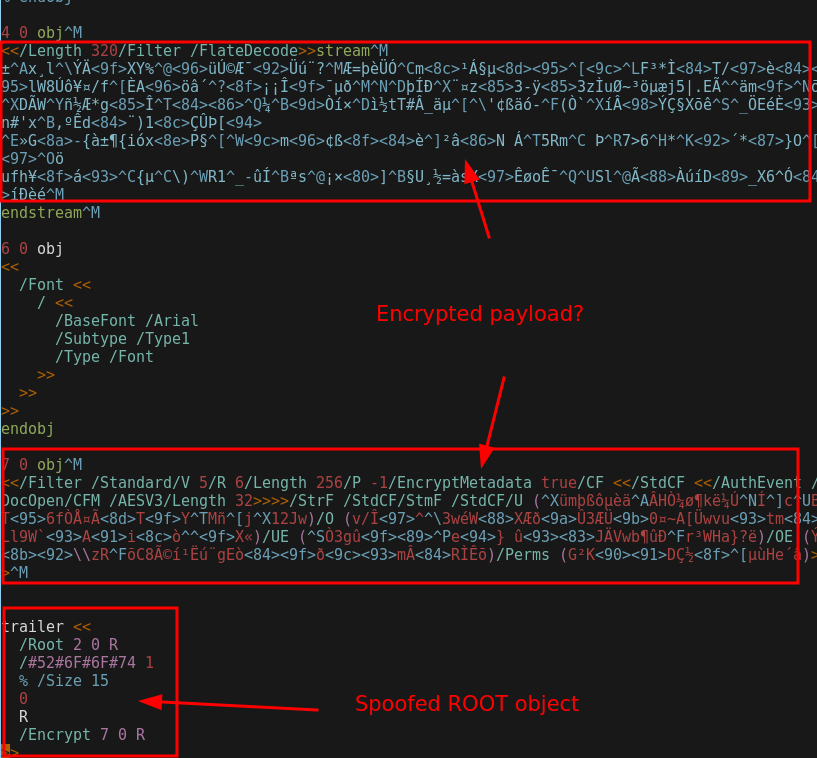
I wish I had a nice and structured way of solving this next step, but it really came down to painstakingly trying out all the PDF tools I could find on Google, until finally finding one that eventually works.
For me that was qpdf:
$ qpdf --decrypt pretty_devilish_file.pdf output.pdf
This gives us a way cleaner PDF file, that also reveals a hidden compressed image in stream 4 of the file:
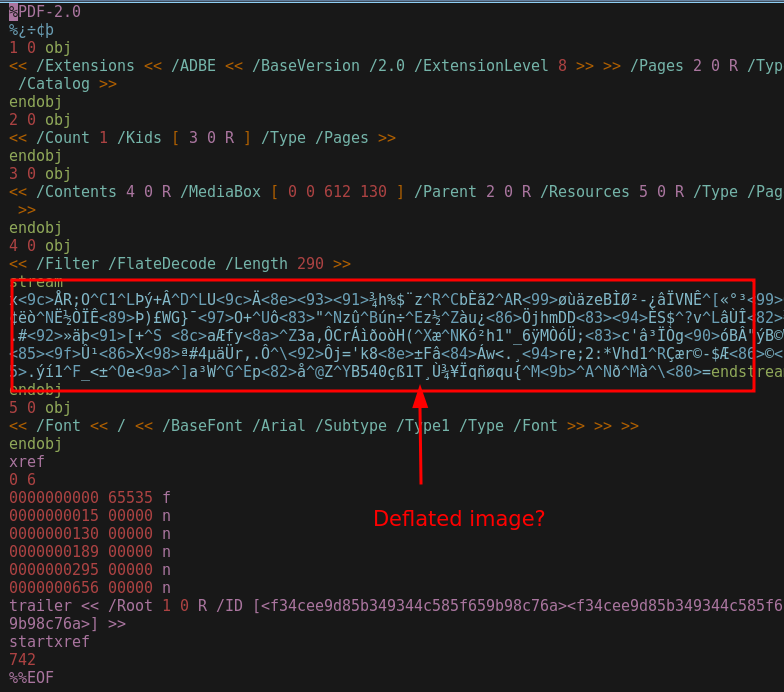
Since the stream is marked by /FlateDecode, we can carve out this image using a hex editor and inflate the buffer using zlib:
import zlib

compressed = bytes.fromhex("78 9C C5 52 3B 4F 03 31 0C DE FD 2B C2 04 0C 55 9C C4 8E 93 91 BE 68 25 24 A8 7A 12 03 62 C8 E3 32 01 52 99 F8 F9 E4 7A 65 42 CC D8 B2 2D BF E2 CF 56 4E CA 1B AB B0 B3 99 D4 A2 EB F2 0E CB BD D2 CF CA 89 DE 29 A3 57 47 7D AF 97 4F 2B 15 F4 83 22 0E 7A FB 02 FA 6E F7 05 7A BD 1A E0 75 BF 86 D6 6A 68 6D 44 44 83 94 C8 53 24 7F 76 0C E2 D9 CE 82 BD 2E 23 92 BB E4 FE 91 5B 2B 13 A0 8C 61 C6 66 79 8A 1A 33 61 2C D4 43 72 C1 EC F0 6F F2 48 28 18 E6 0E 4B F3 B2 68 31 22 5F 36 FF 4D D2 F3 DC 3B 83 63 27 E2 B3 CF D2 67 90 F3 42 C2 22 FD 42 A9 57 85 9F DB B9 86 58 98 AA 23 34 B5 E4 DC 72 2C 2E D4 1C 92 D4 6A 3D 27 6B 38 8E B1 46 E2 84 C1 77 3C 2E B8 94 72 65 3B 32 3A 2A 56 68 64 31 12 C7 E6 72 A9 AD 24 C6 86 A9 85 2E FD ED 31 06 5F 3C B1 0F 65 9A 1D 61 B3 57 07 05 70 82 E5 00 5A 19 42 35 34 30 E7 DF 31 54 B8 D9 BE A5 CF 71 F1 F8 71 75 7B 0D 9B 01 0E F0 0D E0 1C 80 3D")

print(zlib.decompress(compressed))
This reveals some raw JPEG image data (recognizeable from the JFIF header FF D8 FF E0 00 10 4A 46 49 46 00 01):
b"q 612 0 0 10 0 -10 cm\nBI /W 37/H 1/CS/G/BPC 8/L 458/F[\n/AHx\n/DCT\n]ID\nffd8ffe000104a46494600010100000100010000ffdb00430001010101010101010101010101010101010101010101010101010101010101010101010101010101010101010101010101010101010101010101010101010101ffc0000b080001002501011100ffc40017000100030000000000000000000000000006040708ffc400241000000209050100000000000000000000000702050608353776b6b7030436747577ffda0008010100003f00c54d3401dcbbfb9c38db8a7dd265a2159e9d945a086407383aabd52e5034c274e57179ef3bcdfca50f0af80aff00e986c64568c7ffd9\nEI Q \n\nq\nBT\n/ 140 Tf\n10 10 Td\n(Flare-On!)'\nET\nQ\n"
We can carve out again the compressed pixel data and turn it into a bitmap image file:
from PIL import Image
from io import BytesIO

s= bytes.fromhex("ffd8ffe000104a46494600010100000100010000ffdb00430001010101010101010101010101010101010101010101010101010101010101010101010101010101010101010101010101010101010101010101010101010101ffc0000b080001002501011100ffc40017000100030000000000000000000000000006040708ffc400241000000209050100000000000000000000000702050608353776b6b7030436747577ffda0008010100003f00c54d3401dcbbfb9c38db8a7dd265a2159e9d945a086407383aabd52e5034c274e57179ef3bcdfca50f0af80aff00e986c64568c7ffd9")
im = Image.open(BytesIO(s))
im.save('result.png')
This gives us a teeny tiny image.

Zooming in we can see it is a small 1-pixel tall image of seemingly random shades of gray:
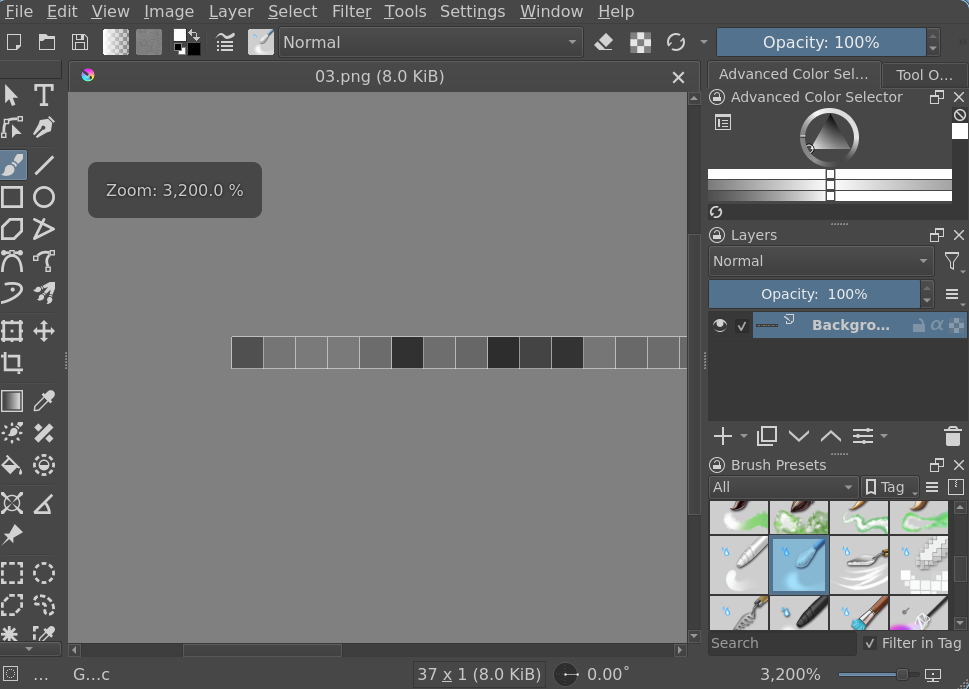
This screams steganography to me. We can try interpreting some of the pixel colors as bytes:
for i in range(37):
    print(chr(im.getpixel((i,0))), end='')
Which reveals the flag:
Puzzl1ng-D3vilish-F0rmat@flare-on.com
Final Words
I don’t like these challenges. It’s pure luck that I found the right PDF reader and the right steganography decoding. I wasted a good amount of time just guessing what the author wants rather than actually reversing something and testing your skills.
Yea this type of challenge I would preferably not have again.